

 English
 Danish
 French
 Swedish
 Vietnamese
 Spanish
 German
 Polish
 English




How can air filtration improve biosecurity in pig houses?
Why clean incoming air matters for pig health and biosecurity
Good ventilation is essential in a modern pig house. It helps control temperature, humidity and air quality while removing excess heat, moisture, dust and harmful gases.
But ventilation is also an important part of biosecurity.
Air entering a pig house can contain dust, microorganisms and other airborne particles. In areas with a high density of pig production, airborne transmission can become an additional route by which infectious agents move between herds.
This means that a ventilation system does more than move air.
It can also form part of the farm's strategy for controlling what enters the pig house.
WOAH states that good air quality and ventilation are important for pig health and welfare and can reduce the risk of respiratory discomfort and disease. It also identifies dust, microorganisms, ammonia, hydrogen sulphide and other airborne contaminants as potential problems in indoor pig housing.
So, how can air filtration help reduce the risk of airborne infection while maintaining good ventilation?
Air can be a route for infection
Biosecurity plans traditionally focus on animals, people, vehicles, equipment and hygiene.
Air is another potential route.
Research has shown that some important pathogens affecting pigs can be transmitted through aerosols. PRRS virus is one of the best documented examples, and studies have demonstrated that airborne transmission can occur between infected and susceptible pigs under controlled conditions.
This does not mean that every airborne exposure will result in infection. Risk depends on factors such as the pathogen, concentration, distance, environmental conditions and the susceptibility of the pigs.
But where the risk of airborne transmission is considered significant, filtering the incoming air can provide an additional layer of biosecurity.
What does air filtration do?
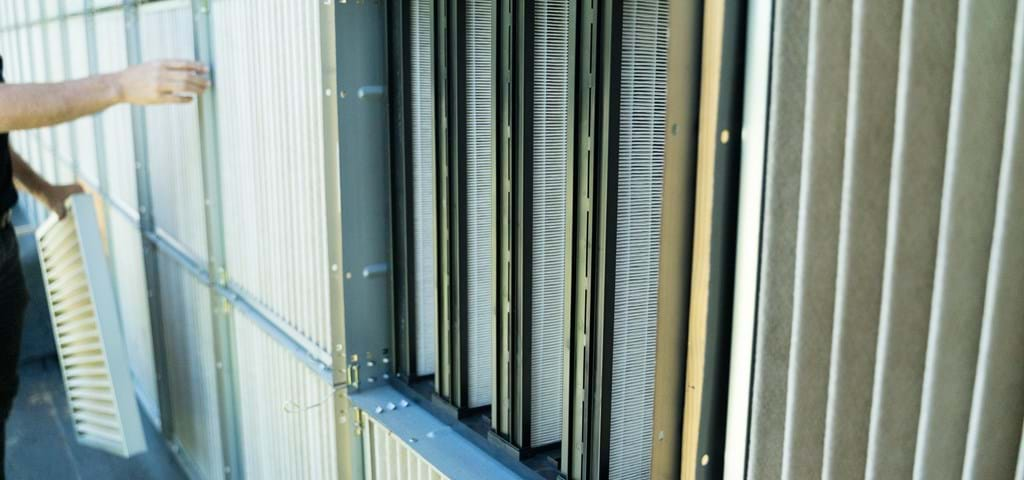
An air filtration system removes particles from the air before that air enters the pig house.
Depending on the filter design and efficiency, this can include particles carrying microorganisms and other airborne contaminants.
The principle is straightforward:
Outside air → filtration → clean incoming air → pig house
The filter therefore acts as a physical barrier between the external environment and the pigs.
Air filtration should not be seen as a replacement for cleaning, animal management or other biosecurity measures. It is an additional control point that can help reduce one specific route of pathogen introduction.
What does research say about air filtration in pig production?
The evidence for air filtration is particularly strong in relation to airborne PRRSV.
In a controlled experimental study, researchers evaluated a commercial air-filtration system incorporating pre-filtration and high-efficiency filters. Aerosol transmission of PRRSV occurred in the non-filtered control group, while all pigs exposed to filtered air remained negative during the study.
A second study compared several filtration approaches and found that HEPA filtration significantly reduced PRRSV transmission compared with no intervention. Other high-efficiency filtration systems also reduced transmission.
The findings are supported by a 2023 review of technologies for controlling aerosol-based disease transmission in animal agriculture. The review identifies fibrous filter media as an established technology that has been demonstrated to reduce the spread of PRRSV between swine production facilities.
This is important because it shows that air filtration is not simply a theoretical concept. It has been investigated experimentally as a biosecurity measure in pig production.
Air filtration is one part of biosecurity
Filtration should never stand alone.
A strong biosecurity programme combines several measures designed to prevent pathogens from entering and spreading within the farm.
These can include:
- Health screening and control of incoming animals
- Visitor and staff hygiene
- Cleaning and disinfection
- Controlled movement between sections
- Pest control
- Equipment hygiene
- Feed and water management
- Appropriate ventilation
- Air filtration where relevant
SEGES Innovation emphasises that biosecurity in pig production includes measures to prevent infection from entering the herd and to limit spread within the herd.
The Danish authorities likewise describe biosecurity as a combination of measures designed to prevent introduction and spread of infection.
The practical principle is simple:
The more transmission routes you can control, the more robust the overall biosecurity strategy becomes.
Good ventilation still comes first
Filtering incoming air does not change the fundamental purpose of the ventilation system.
The pig house still needs sufficient air exchange to remove:
- Excess heat
- Moisture
- Carbon dioxide
- Ammonia
- Dust
- Other contaminants
WOAH states that ventilation should provide good air quality without creating harmful draughts, while controlling heat and the accumulation of gases and dust in the housing environment.
Danish pig-production guidance likewise points to ventilation as essential for maintaining acceptable air quality and removing excess heat and moisture.
This means that an air filtration solution has to be designed together with the ventilation system.
Airflow, filter resistance, air intake, pressure and system capacity all need to work together.
What about dust?
Air filtration can also influence the amount of airborne particulate matter entering a building.
Research on pig-house air filtration has shown that filtration can reduce airborne particulate concentrations, although the effect depends on the filtration system and how it is used. In one commercial-farm study, recirculating air filtration resulted in the lowest measured total dust concentration among the tested systems.
This is relevant because dust in pig houses is not only a cleanliness issue.
Dust can carry microorganisms and other biological material, while poor air quality can contribute to respiratory challenges for animals and people working in the building.
Air filtration can therefore be considered as one component in a broader strategy for cleaner incoming air and better control of airborne contaminants.
Air filtration can be especially relevant in high-density pig areas
The value of filtered incoming air depends on the situation.
Airborne disease risk is influenced by factors such as:
- Density of pig production in the surrounding area
- Health status of neighbouring herds
- Local disease situation
- Ventilation design
- Building location
- Production type
- Biosecurity strategy
Research on PRRSV has helped drive the adoption of air filtration in high-density swine-producing regions where airborne transmission represents a recognised biosecurity concern.
For some farms, conventional biosecurity measures may provide sufficient protection. For others – particularly high-health breeding herds in areas with significant airborne disease risk – filtered incoming air can provide an additional layer of protection.
The decision should therefore be based on a risk assessment rather than a one-size-fits-all approach.
How does an air filtration system affect the ventilation system?
Adding filters to a ventilation system introduces additional resistance to airflow.
This makes correct system design important.
The filter system needs to be matched to:
- Required air capacity
- Filter efficiency
- Available pressure
- Building type
- Air intake design
- Ventilation control
- Maintenance requirements
Filters also need to be inspected and maintained according to the system design.
A blocked or poorly maintained filter can increase pressure losses and affect ventilation performance.
This is why air filtration should be designed as an integrated part of the ventilation system, not simply added afterwards.
SKIOLD AirFilter: filtering the air before it enters the pig house
SKIOLD has developed the SKIOLD AirFilter system specifically for pig-house ventilation.
The system filters incoming air and is designed to reduce the risk of airborne introduction of bacteria and viruses.
According to SKIOLD, the system can filter up to 95% of viruses and bacteria from incoming air, and the company states that it can reduce the risk of reinfection by up to 80% under comparable infection conditions. The system is available for both new and existing buildings and can be integrated with different fresh-air ventilation principles.
SKIOLD offers three main configurations:
- Filter CL100 Wall for negative-pressure systems with wall air inlets
- Filter CL200 Ceiling for negative-pressure systems with ceiling inlets
- Filter Unit for equal- and positive-pressure systems
This makes the technology suitable for different building and ventilation configurations.
Air filtration does not replace good management
It is important to be realistic about what air filtration can achieve.
A filter cannot compensate for poor hygiene, uncontrolled animal movement or inadequate management.
It is best understood as an additional barrier within a broader biosecurity programme.
The strongest approach combines:
Good hygiene + controlled management + effective ventilation + appropriate air filtration
Together, these measures can reduce the number of opportunities for pathogens to enter and spread through the herd.
When should you consider filtered incoming air?
Air filtration may be particularly relevant when:
- The farm is located in a high-density pig-producing area
- Airborne disease risk is considered significant
- The farm has high-health or high-value breeding animals
- Additional biosecurity barriers are required
- A new ventilation system is being designed
- An existing building is being upgraded
- The farm wants to reduce dependence on a single biosecurity measure
A farm-specific risk assessment is the best starting point.
The objective is not simply to install a filter.
The objective is to create the right level of protection for the farm's actual disease and production risks.
Cleaner incoming air as part of a stronger biosecurity strategy
Ventilation is essential for a healthy pig-house environment, but the air entering the building can also represent a potential biosecurity route.
Research has demonstrated that appropriate air filtration can reduce airborne transmission of important pig pathogens, particularly PRRSV.
For farms where airborne transmission represents a relevant risk, filtering incoming air can therefore provide an additional layer of protection.
The best results come when filtration is integrated with the rest of the ventilation system and combined with good hygiene, management and biosecurity.
Good air quality supports pig health.
Clean incoming air can strengthen biosecurity.
And well-designed ventilation brings the two together.
Contact SKIOLD
Need to know more about designing the optimal pig house?
Contact us today for a non-binding conversation about how the design of pig housing and the choice of equipment can support efficient and healthy pig production.
👉 Contact SKIOLD | Find dealers and locations
Read more about our pig farm solutions:
👉 Pig Farm Solutions | SKIOLD
Follow us and get inspired on social media:
😊 Facebook LinkedIn
Sources and further reading
WOAH – Terrestrial Animal Health Code: Welfare of pigs
https://www.woah.org/fileadmin/Home/eng/Health_standards/tahc/2024/en_chapitre_aw_pigs.htm
Dee et al. – Evaluation of an air-filtration system for preventing aerosol transmission of PRRSV
https://pubmed.ncbi.nlm.nih.gov/16479728/
Dee et al. – Further evaluation of alternative air-filtration systems for reducing PRRSV transmission
https://pubmed.ncbi.nlm.nih.gov/16850938/
Hartung et al. – Impact of different supply air and recirculating air filtration systems on stable climate, animal health and performance of fattening pigs
https://pubmed.ncbi.nlm.nih.gov/29558482/
Control technologies to prevent aerosol-based disease transmission in animal agriculture production settings – review
https://pubmed.ncbi.nlm.nih.gov/38033641/
SEGES/Svineproduktion – Luftrensning
https://svineproduktion.dk/viden/i-stalden/staldsystem/miljoeteknologi/luftrensning
Danish Veterinary and Food Administration – Biosecurity
https://foedevarestyrelsen.dk/dyr/dyresundhed/smittebeskyttelse
SKIOLD – AirFilter system
https://skiold.com/pig/equipment/climate-in-pig-houses/climate-solutions/skiold-airfilter-system


