

 English
 Danish
 French
 Swedish
 Vietnamese
 Spanish
 German
 Polish
 English



Dairy Feed Mill in Vietnam: Lower Feed Costs and 10% Higher Milk Production
Producing its own feed gives TH Milk greater control, lower costs and higher milk yields
TH Milk was established in Vietnam in 2009 with the ambition of bringing fresh, high-quality milk to Vietnamese consumers. Today, the dairy operation has around 40,000 cattle, including approximately 20,000 milking cows and 20,000 young animals.
The farm produces around 200 million litres of milk annually, with production continuing to grow year by year. Average milk production is approximately 10,000 litres per cow per year, which is a very high yield by international standards.
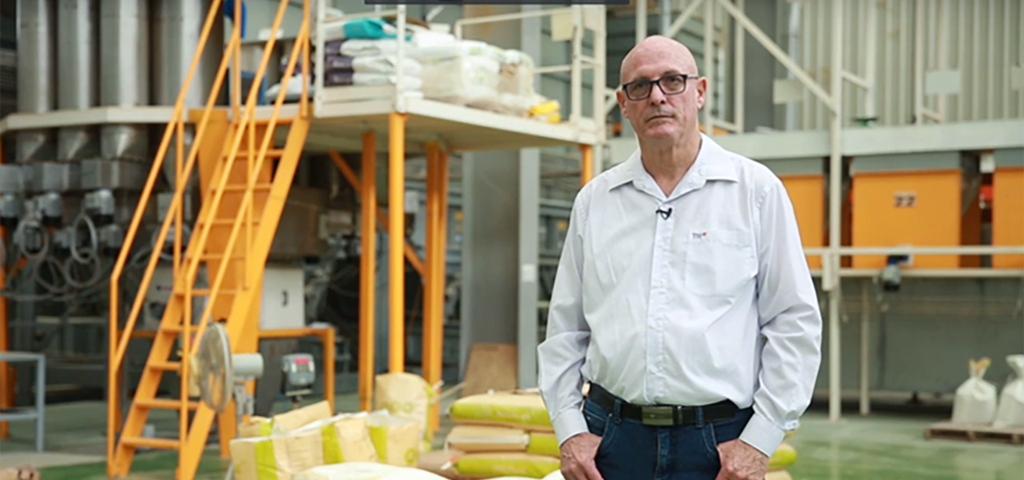
A key part of TH Milk's success is its investment in a complete SKIOLD feed mill, which gives the farm control over its own feed production, raw materials and feed formulations.
Complete control of feed production
For TH Milk, producing feed in-house is about more than reducing costs. It gives the farm the ability to control the quality of the raw materials and respond quickly when the nutritional needs of the herd change.
With its own feed mill, TH Milk can change a feed formulation and begin producing the new feed within just 1–2 hours.
This is a major advantage compared with relying on external feed suppliers, where changes to feed formulations can take considerably longer.
The farm can also decide exactly which raw materials to use and exclude ingredients that do not meet its quality requirements.
“Having our own feed mill enables us to change the feed formula very fast – as quickly as in only one to two hours. We can react faster, more accurately and at the lowest cost.”
— Hanan Saggi, Dairy Feed Nutritionist, TH Milk
100% self-sufficient in feed production within four months
The SKIOLD feed mill started production in August 2018 and reached full capacity within its first two months.
Just four months after commissioning, TH Milk was producing 100% of the concentrate feed required for its cattle, making the operation self-sufficient in feed production.
The feed mill produces approximately 300–350 tonnes of feed per day, equivalent to around 10,000 tonnes per month.
The installation has also been designed with future growth in mind. If production needs to increase, the feed mill can operate seven days a week in three shifts.
Feed costs reduced to 60% of previous cost
Producing its own feed has had a significant impact on TH Milk's feed costs.
Once the feed mill reached full production, feed costs were reduced to approximately 60% of the previous cost of purchased feed.
That means a reduction of around 40% compared with the previous feed cost.
And because TH Milk continuously improves its feed production and formulations, the expectation was that the results would improve further over time.
“After reaching full production of our own feed, our costs have been reduced to 60% compared to the costs we had when we purchased feed. And I am convinced that we can reach even better results as we get better and better at producing the feed every day.”
— Hanan Saggi, Dairy Feed Nutritionist, TH Milk
High milk yields through precise feed management
The combination of precise feed production and close control of the entire dairy operation has contributed to significant improvements in milk production.
Between 2017 and 2018, average milk production increased by 2.5 litres per cow per day. This corresponds to approximately 900 additional litres per cow per year and an overall 10% increase in milk production.
TH Milk's ambition was to increase production by a further 1.5 litres per cow per day, with the long-term goal of reaching 12,000 litres of milk per cow per year.
For a herd of this size, even relatively small improvements in production per cow can have a major impact on total milk output.
Effective grain cleaning reduces mycotoxins and the need for toxin binders
TH Milk operates under challenging climatic conditions, with a Temperature Humidity Index (THI) above 80 for more than six months of the year. These conditions create a significant risk of heat stress for dairy cattle and make strict control of feed quality particularly important.
A key part of TH Milk's feed quality strategy is the effective cleaning of grain and raw materials before they are used in feed production. By removing impurities and grain fractions where mycotoxins are concentrated, the cleaning process helps reduce the level of mycotoxins entering the feed production process.
This allows TH Milk to maintain very low mycotoxin levels in its feed and milk and significantly reduces the need for toxin binders.
TH Milk carries out extensive quality control throughout the production process. More than 10 milk samples are checked every day, while milk is tested for aflatoxin approximately 4,000 times per year. Raw materials, forage and by-products are also regularly tested.
The combination of effective grain cleaning, strict raw material control and continuous testing has enabled TH Milk to maintain mycotoxin levels at very low levels comparable with European standards.
As a result, TH Milk has been able to eliminate the use of toxin binders in its feed formulations, generating estimated savings of approximately USD 500,000 per year.
“We have realized that we do not need to use toxin binders in our formula, and therefore we save 500,000 dollars per year.”
— Hanan Saggi, Dairy Feed Nutritionist, TH Milk
Feed production designed for future growth
TH Milk's approach is based on controlling as much of the production process as possible.
The feed mill is an important part of this strategy, allowing the company to control the quality, composition and cost of the feed supplied to its cattle.
The installation has been designed to support future expansion. With the ability to operate seven days a week in three shifts, the feed mill has sufficient flexibility to increase production as the dairy operation grows.
For TH Milk, the investment in its own feed mill has therefore become an important part of building an efficient, scalable and competitive dairy production system.
Results
The SKIOLD feed mill has helped TH Milk achieve:
- Feed costs reduced to approximately 60% of the previous cost
- Approximately 40% lower feed costs compared with purchased feed
- 10% increase in milk production
- 2.5 litres more milk per cow per day
- Approximately 900 additional litres per cow per year
- 100% self-sufficiency in concentrate feed production within four months
- Ability to change feed formulations within 1–2 hours
- Production of approximately 300–350 tonnes of feed per day
- Full control over raw materials and feed quality
- Reduced need for toxin binders
- Estimated savings of approximately USD 500,000 per year from eliminating toxin binders
- Feed production capacity prepared for future expansion
A complete feed production solution for large-scale dairy farming
The SKIOLD feed mill gives TH Milk the capacity and flexibility needed to produce feed for a large dairy herd while maintaining close control over feed quality and formulation.
By bringing feed production in-house, TH Milk has reduced its dependence on external feed suppliers and gained the ability to respond rapidly to changes in production requirements.
The result is a highly flexible feed production setup that supports lower feed costs, high milk yields and continued growth.
“We want to manage as much as we can on our own. We bought the feed mill because we wanted to control this part, too. Now that we know how the feed mill and feed production work, we know that we made a good choice.”
— Hanan Saggi, Dairy Feed Nutritionist, TH Milk
Facts
- Location: Vietnam
- Herd: Approx. 40,000 cattle
- Milking cows: Approx. 20,000
- Annual milk production: Approx. 200 million litres
- Milk yield: Approx. 10,000 litres/cow/year
- Feed production: Approx. 300–350 tonnes/day
- Feed production: Approx. 10,000 tonnes/month
- Self-sufficiency: 100% own concentrate feed production after four months
- Feed formulation changes: Within 1–2 hours
- Milk production increase: 10%
- Additional milk production: Approx. 900 litres/cow/year
- Application: Large-scale dairy feed production